
Blog
Debra Wheatman, President of Careers Done Write, provides expert insight to the job search process that puts your career in gear with tips for interviewing, networking, job search strategies and how to create a winning resume and cover letter.

Is, Ought, and Your Career
David Hume’s famous observation in A Treatise of Human Nature—often referred to as the Is-Ought Problem or Hume’s Law—posits a fundamental barrier in moral philosophy: one cannot logically derive a moral imperative (an "ought") purely from a set of factual statements (an "is"). In simple terms, no amount of objective data, statistical facts, or observational reality can tell us what we should do without an underlying human desire, value, or emotional commitment driving the transition. Although Hume originally framed this concept to critique conventional moral systems, applying Hume’s Ought Theory to professional life offers a surprisingly practical blueprint for navigating career decisions, evaluating market demand, and preventing professional burnout….

Four Daily Habits That Quietly Accelerate Your Career
Elevating your career trajectory doesn’t always require a complete professional overhaul, an expensive executive degree, or an extra twenty hours of overtime every week. Often, the biggest leaps come from refining the foundational behaviors that shape how leadership, peers, and clients perceive you….

Architecting Your Professional Life: Why Your Career Deserves More Strategy Than Your Vacation
We will spend roughly 80,000 hours of our lives at work. That is about one-third of our entire adult existence, second only to sleeping. Yet, most people do not devote intentional time to planning out their professional paths. Most people spend more time researching hotel reviews than mapping out their next five years of career growth. We obsess over optimizing a seven-day trip to ensure maximum enjoyment, but treat our daily work life as something that simply happens to us by default. Breaking this cycle and taking control of your career architecture is essential for several critical reasons….

Leverage the Overton Window to Manage Your Career
Navigating a corporate career is as much about managing perception, influence, and alignment as it is about operational output. While hard skills and domain expertise set a foundation, long-term advancement often depends on understanding the unwritten boundaries of organizational culture. In political theory, the Overton window describes the range of ideas, policies, and discourse considered acceptable by the general public at any given time. When applied to the corporate world, the Overton window represents the spectrum of behavior, innovation, and communication deemed safe, professional, and strategic within a specific company….

Reclaiming Your Career from Parkinson’s Law
We often confuse being busy with being effective. If we have eight hours to fill, we will fill it with minor details, extra formatting, or unnecessary research to feel like we put in a full day's work. In the modern corporate world, this manifests as endless email threads, over-engineered slide decks, and back-to-back meetings that could have been handled in a single message. We treat our workdays like expanding balloons, stretching tasks until they consume every waking hour, leading to burnout without necessarily driving meaningful results….

From Peer to Boss: The Survival Guide for New Managers
Congratulations! You got the promotion. You’ve traded in your old responsibilities for a shiny new title, a bump in pay, and… a sudden, overwhelming wave of imposter syndrome. First, take a deep breath. What you are feeling is completely normal. Transitioning from an individual contributor to a manager is one of the sharpest learning curves in any professional career. To help you navigate the messy, rewarding, and chaotic first few months, here is a practical guide to surviving and thriving in your new role….

Grody to the Max: Your Food Court Style Resumé Is Like Totally Lame.
In the 1980s, mall culture was at its peak. Walking into a suburban American mall in the 1980s wasn’t just a shopping trip—it was an immersive sensory experience. It was the undisputed epicenter of teenage social life, consumer optimism, and suburban monoculture. Storefronts competed for attention with brilliant, custom neon signage. Dark glass, mirrored ceilings, and polished chrome trim reflected the pink, cyan, and electric blue hues glowing from every window. The crowd was a moving showcase of the decade’s fashion: acid-washed denim, oversized blazers with shoulder pads, Member Only jackets, neon windbreakers, and hair sprayed to gravity-defying heights. Walking past the arcade meant hitting a wall of sound: a chaotic mix of electronic bleeps, pixelated explosions, and synthesized speech from games like Pac-Man, Galaga, and Donkey Kong, all backed by the heavy thud of plastic tokens dropping into metal slots. Walking near a department store anchor meant walking through a cloud of heavy designer perfumes and colognes sprayed by workers at the beauty counters. The communal areas of the mall were blanketed in a haze, and their air carried the stench of cigarette smoke, which, combined with Aqua Net, was the official aroma of the decade….
The Myth of Meritocracy
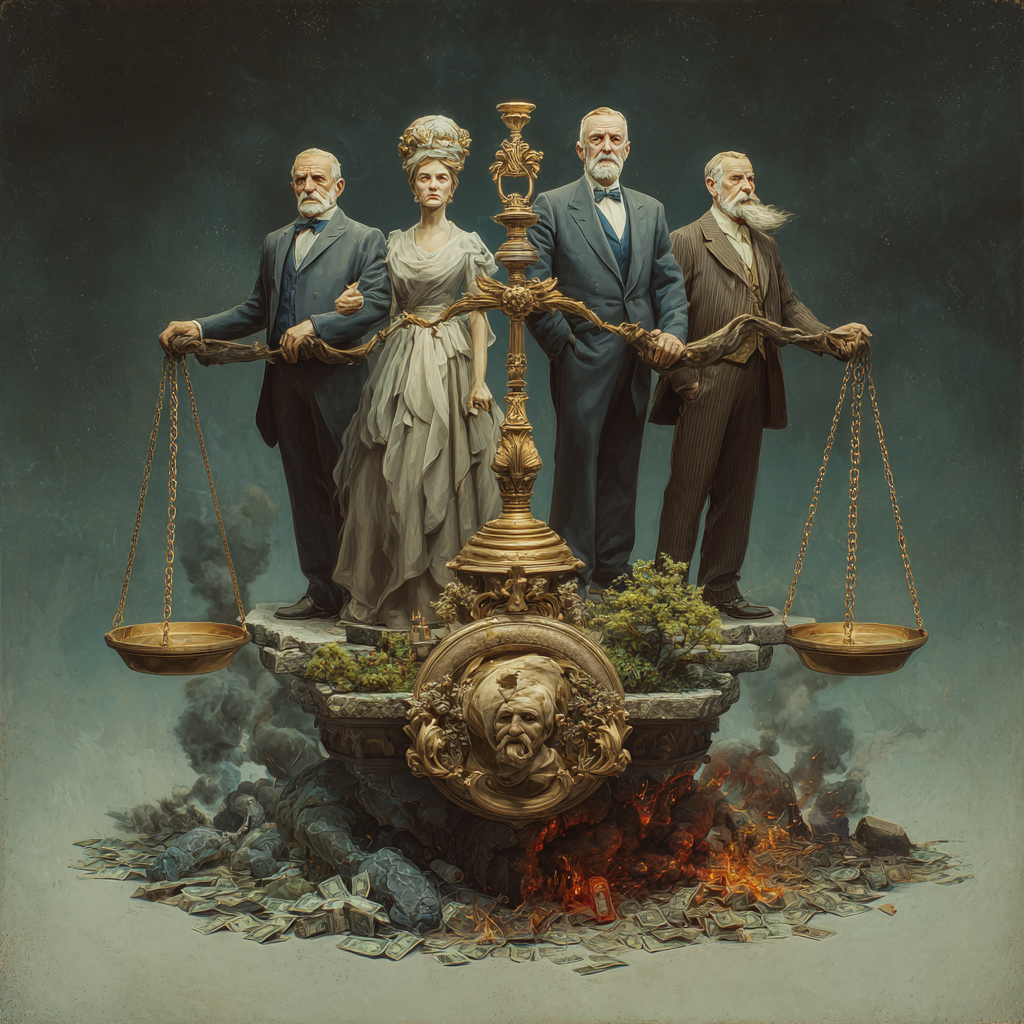
The term “meritocracy” has undergone a radical and perhaps tragic linguistic evolution. Coined not as a goal to be achieved but as a warning to be avoided, the concept originated in Michael Young’s 1958 satirical novel, The Rise of Meritocracy. Young’s dystopian vision of a future Britain was organized by a rigid social formula: Intelligence + Effort = Merit. In this world, social status was no longer determined by the circumstances of birth or aristocracy, but by objective metrics like IQ. Yet, this shift did not create a more just society; instead, it created a more arrogant one. Young’s primary thesis was that meritocracy is not a solution to inequality, but a more sophisticated way of justifying it….

The Downfall of Betamax and Why “Best” Is Subjective
Our story begins in the early 1970s, when several electronics companies were experimenting with ways to bring video recording into ordinary households. Before videocassette recorders, consumers had little control over television viewing. Programs could only be watched when they aired unless someone had access to expensive professional recording equipment….

Kairos: Use the Force to Land Your Next Job
The ancient Greeks defined three primary modes of persuasion: Ethos, Pathos, and Logos, which focus on the speaker's credibility, the audience's emotions, and logical facts, respectively. Aristotle argued that a truly effective argument does not rely on just one of these pillars, but rather a balanced integration of all three. Beyond these primary modes, the Greeks emphasized Kairos, the opportune moment to deliver a message. While the three primary pillars provide the substance of an argument, Kairos acts as the glue that ensures an argument succeeds by being delivered in the correct context….